Screw-retained and cement-retained restorations are two common pathways in implant dentistry—but selecting the right option depends on far more than preference. From retrievability and peri-implantitis prevention to esthetics and lab design, this guide explores when screw-retained implants truly offer superior outcomes.
Screw-retained implants eliminate excess cement risks and simplify future maintenance, while cemented restorations may offer esthetic flexibility—clinical conditions should determine which is best.
While both designs can be successful, their retention methods create meaningful differences in clinical workflow, complications, and long-term management.
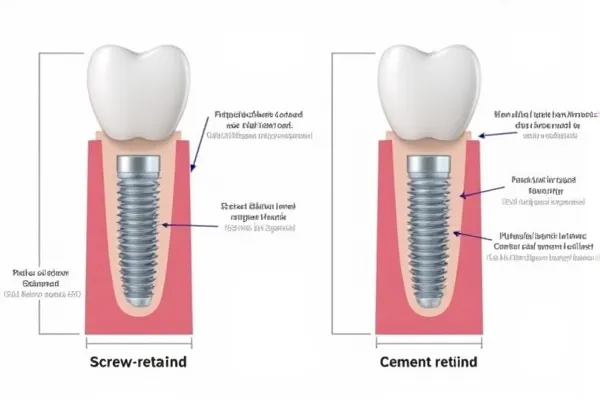
Diagram showing cemented vs screw-retained crown retention
Retention governs how the final prosthesis is secured and affects how it’s repaired or adjusted later.
Clinical implication: Screw designs excel when frequent retrieval or minimal soft tissue disruption is prioritized.
The placement sequence influences appointment length, technique sensitivity, and rework options.
| Workflow Step | Screw-Retained | Cemented |
|---|---|---|
| Try-in & occlusion check | Easily repeatable | Cement set may limit changes |
| Restoration seating | Can be verified dynamically | Once bonded, no reversibility |
| Final torque & polish | Completed intraorally | Requires cement cleanup time |
| Cement control | Not needed | Crucial to prevent inflammation |
Maintenance protocols differ dramatically.
Real-world value: Easy retrievability improves long-term implant serviceability.
Each design serves different zone priorities.
✅ Screw-retained implants provide clinical control and lower long-term risk – TRUE
Explanation: They offer reliable fit, lower biological risk, and retrievability.
❌ Cemented implants outperform screws in all cases – FALSE
Explanation: Cement increases peri-implantitis risk and retrieval difficulty.
Clinical complexity, anatomic constraints, and patient risk factors often make screw-retained implants the superior option.
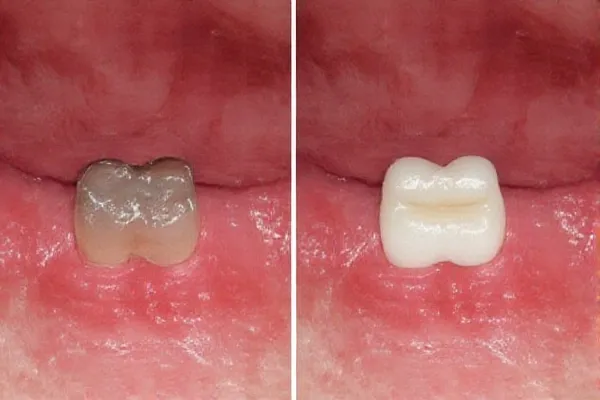
Clinical scenarios favoring screw-retained implants
Vertical height affects margin visibility, cement extrusion, and restoration bulk.
Scenario: Posterior molars with high opposing occlusion—tight vertical room makes cement removal unreliable.
Complex implant paths require precision and reversibility.
Clinical pearl: ASC systems allow screw access in esthetic zones without sacrificing design.
Biologic risk demands minimal inflammation sources.
| Risk Factor | Impact on Cemented Restorations |
|---|---|
| Poor hygiene | Missed cement = chronic inflammation |
| Deep tissue depth | Hard to access margins |
| History of periodontitis | Increases breakdown from cement residue |
| Limited follow-up visits | Delayed detection of cement complications |
Speed, predictability, and flexibility are critical.
✅ Screw retention is ideal in constrained, risky, or complex clinical conditions – TRUE
Explanation: It offers precision, safety, and reversibility.
❌ These cases are best served by cementation – FALSE
Explanation: Cement increases technical risk in complex workflows.
Despite wide use, cementable crowns carry significant risks that can compromise outcomes if not managed precisely.
Cement-related complications in implant prosthetics
Cement residue is a primary cause of biological failure.
Case example: Anterior implant crown with clean esthetics, but post-placement tissue swelling revealed hidden cement at 6-month follow-up.
Once cemented, retrieval becomes destructive.
| Scenario | Screw-Retained | Cemented |
|---|---|---|
| Loose crown reattachment | Easily retorqued | Must be cut and replaced |
| Abutment screw check | Accessible | Often impossible |
| Occlusal modification | Reversible | May require remake |
| Crown fracture | Crown removable | Entire unit destroyed |
Margin location dictates success or failure.
Long-term biological risk is statistically higher.
✅ Cement increases biological risk, especially in deep tissue or low visibility zones – TRUE
Explanation: Even small amounts of cement can initiate long-term breakdown.
❌ Cemented restorations are complication-free if done well – FALSE
Explanation: Risks persist even with meticulous delivery.
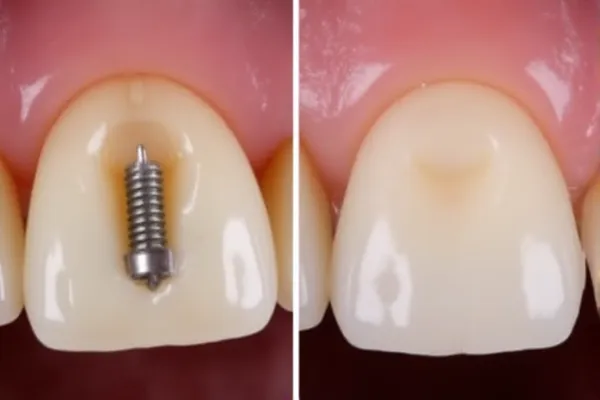
Esthetics often drive decision-making—but proper technique can deliver beautiful results with either design.

Screw-retained and cemented anterior crowns
Visibility is the #1 esthetic concern.
Composite techniques have improved, but limitations remain.
Gingival health affects long-term esthetics.
| Feature | Cemented Crown | Screw-Retained Crown |
|---|---|---|
| Margin control | Subgingival | Limited to screw path |
| Papilla sculpting | Easier | Requires more customization |
| Tissue rebound | More predictable | Must use custom healing caps |
Design flexibility influences esthetics.
✅ Cemented crowns offer more freedom in the esthetic zone – TRUE
Explanation: Subgingival margins and abutment angulation improve visual outcomes.
❌ Screw-retained crowns always look worse – FALSE
Explanation: ASC, custom abutments, and composites now enable esthetic success.
Even the best plan fails if lab tools or systems can’t support it.

CAD design of screw-retained and cemented restoration
Not all platforms are equal.
Digital workflows enhance precision.
Full-arch restorations require different engineering.
| Prosthesis Type | Preferred Retention |
|---|---|
| All-on-4 or 6 Hybrid | Screw-retained via MUAs |
| Individual posterior | Case-dependent |
| Temporary bridges | Screw for removability |
Efficiency vs. long-term value.
✅ Lab compatibility and system design determine retention feasibility – TRUE
Explanation: Some labs and platforms support one method better than the other.
❌ You can always choose based on preference alone – FALSE
Explanation: Workflow, design tools, and platform shape limit that freedom.
The decision between screw-retained and cemented implant restorations is not just about preference—it’s about clinical suitability, long-term predictability, and risk control. While screw-retained designs offer significant advantages in retrievability and biological safety, cemented crowns still play a role in anterior esthetics and margin management. An informed, case-by-case decision ensures better outcomes for both clinicians and patients.
Take the Next Step
Want to reduce complications and improve restoration consistency? Talk to us about integrating screw-retained workflows into your practice or upgrading lab collaboration for hybrid protocols.