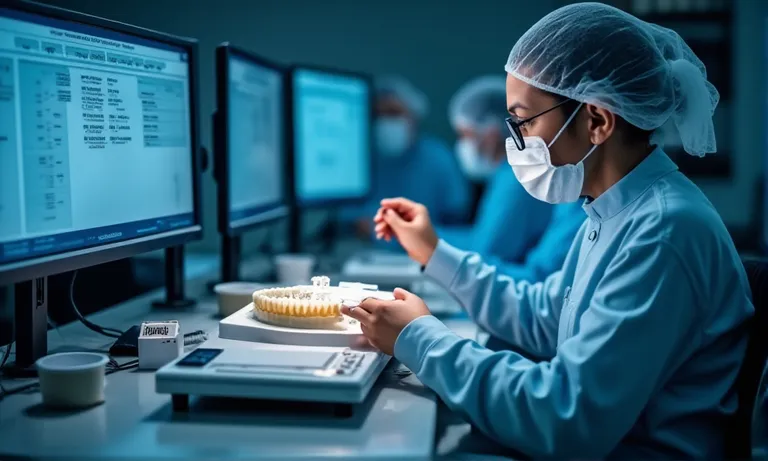
Turnaround time reliability in dental outsourcing refers to a lab’s ability to consistently meet expected delivery dates across varying case types, workflows, and volumes. It reflects not just speed, but operational control, workload planning, and the capacity to handle exceptions.
For dental clinics, DSOs, and procurement teams, assessing a dental lab’s turnaround capability is essential to avoid schedule disruptions and protect patient satisfaction. Yet, stated delivery days alone don’t reveal the full picture. The real question is: can the lab consistently deliver on its promises?
Five key dimensions help uncover whether a lab’s turnaround times can truly be trusted:
Production Predictability Case type, material selection, and workflow method (digital vs traditional) all directly affect lead time and must be factored into planning.
Performance Data & SLAs On-time delivery rates, formal Service Level Agreements, and documented delay tracking provide measurable indicators of reliability.
Tracking & File Control Real-time case status visibility, clear cut-off times for uploads, and swift STL error resolution contribute to predictable case management.
Exception Management A lab’s ability to handle urgent cases, remakes, and unavoidable delays reveals its maturity in risk mitigation under pressure.
Scalability Without Delay Labs with modular technician teams, buffer workflows, and phased delivery systems can grow with your volume—without compromising lead times.
By looking beyond estimated turnaround to actual process integrity, clinics and DSOs can identify truly dependable partners for long-term, scalable outsourcing success.
Key factors that influence turnaround time in outsourced dental restorations
Turnaround time for outsourced dental restorations depends on case complexity, material type, and production workflow. Understanding these factors helps dental practices set realistic delivery expectations and select labs that align with their clinical schedule.
Turnaround-time-factors-dental-lab
How case type, material, and workflow affect lead time
Different restorations have different delivery timelines. A single crown case is not the same as a full-arch implant bridge. Knowing what affects production speed allows clients to plan accordingly.
Case type: Simple cases such as monolithic crowns are typically completed within 4–5 working days. In contrast, complex restorations like implant-supported bridges or layered veneers may require 8–12 days due to multiple phases and precision requirements.
Material: Materials like zirconia or lithium disilicate allow faster processing due to digital compatibility. PFM and layered ceramics often involve extra steps like manual coping or veneering, extending the lead time.
Workflow: Digital files submitted via STL allow faster pre-checks and fewer logistics delays. Analog impressions involve shipping, pouring, and model creation, adding 1–2 days to the timeline.
In-house vs sub-contracted capacity differences
Labs may produce some cases internally and outsource others depending on their equipment and capacity. This directly affects consistency and predictability of turnaround.
Labs with fully in-house workflows tend to provide more reliable turnaround windows. All steps from design to finish occur under one roof, reducing handover delays.
Some labs outsource specialty cases such as cast partials or complex implant bars. These can add 2–4 working days depending on the partner lab’s capacity.
During high-demand periods, even standard cases may be subcontracted. Without clear communication, this can lead to unexpected delays in otherwise simple cases.
Why digital and analog cases follow different production timelines
The method of submission significantly alters production timelines. Digital and analog cases follow different intake, verification, and setup flows.
Submission Type
Typical Turnaround
Common Bottlenecks
Production Entry Point
Digital (STL)
3–5 working days
File errors, margin ambiguity
Immediate CAD workflow
Analog (Impression)
6–9 working days
Shipping delays, model distortion
Manual model setup
Mixed Format
5–8 working days
Conflicts between scan and model
Dual verification step
Understanding these distinctions allows clinics to align case planning with delivery expectations. Labs that offer STL file support and efficient digital intake systems can reduce waiting time, especially when combined with clear prescription data.
✅ Turnaround time depends on multiple technical variables – TRUE Even with the same lab, lead times vary depending on the case type, material, and submission method. Predictability improves when clients are aware of these upstream variables.
❌ All restorations should follow the same 5-day lead time – FALSE Standardizing lead time across all case types ignores essential differences in production needs. This often leads to misalignment between lab workflows and clinic schedules.
How to evaluate a lab’s on-time delivery rate and SLA commitments?
Evaluating a lab’s delivery reliability requires comparing actual performance data with written service guarantees and assessing how delays are tracked and communicated. This structured approach helps practices differentiate between labs that truly deliver and those that rely solely on marketing promises.
lab-on-time-delivery-dashboard
What percentage of cases are delivered on schedule?
On-time delivery statistics provide the most objective measure of turnaround reliability. Review recent performance data by quarter to understand consistency.
An on-time rate above 90% often indicates robust internal scheduling, buffer planning, and technician availability.
A rate below 80% flags potential workflow bottlenecks or equipment downtime.
Ask for verified client testimonials or independent platform reviews showcasing sustained delivery metrics.
Are SLAs in place with specific lead-time guarantees?
A reliable lab outlines defined lead times for each restoration type (e.g., 5 days for single-unit, 10 days for full arch).
Agreements often specify cut-off times, rush case protocols, and remedies for missed deadlines.
High-volume clients or DSO partners typically negotiate custom SLA terms and escalation procedures.
How does the lab track and report delay patterns?
Transparent tracking systems and proactive reporting help identify issues early and enable corrective action.
Confirm whether delays are logged by case type, date, and reason.
Request visibility into periodic delay analysis or monthly summaries.
Check if the lab notifies clients ahead of potential delays and outlines recovery or compensation plans.
✅ A lab’s SLA-backed delivery record reflects real reliability – TRUE Service data, formal agreements, and delay transparency demonstrate actual lab performance beyond marketing claims.
❌ Turnaround promises are enough to trust delivery timelines – FALSE Without SLA documentation or tangible performance data, verbal assurances often fail under production pressure.
What workflow and tracking systems support turnaround predictability?
Workflow predictability depends on how well a dental lab digitizes its case management, tracks deadlines, and communicates issues. Labs with structured submission cut-offs and automated tracking provide greater transparency and schedule alignment for dental clients.
digital-workflow-tracking-dental-lab
Does the lab offer real-time case status or tracking?
Case tracking tools reduce uncertainty by allowing clinics to monitor case progress and anticipate delivery.
Some labs provide online portals that display status indicators such as “received,” “in design,” “in fabrication,” and “shipped.”
Real-time updates prevent delays caused by email back-and-forth, especially across time zones.
Labs using tracking-capable CAD software like exocad DentalCAD offer integrated workflows and status overviews for each job.
What is the cut-off time for daily case submission?
Defining a daily cut-off helps ensure cases enter production on the same day, aligning lab and clinic schedules.
Common cut-off windows are 2–4 PM lab local time.
Submissions received after the cut-off typically join the next production queue, adding 1–2 days to lead time.
Labs with international clients may offer multiple cut-off zones, enabling flexible scheduling that accommodates global practices.
How quickly are STL errors or missing info addressed?
Delays often stem from incomplete digital files. Labs with rapid feedback and correction loops greatly reduce downtime.
Incoming STL files are automatically checked for margin clarity, scan format, and opposing bite data.
If issues arise, alerts or notes are sent to the clinic immediately, prompting correction.
Once corrected data is received, the case re-enters the production queue without delay.
Labs that support STL exports via 3Shape Dental System often have automated pre-check systems to identify file issues early.
Clear communication on file requirements (Rx form, scan bite, design notes) prevents workflow hold-ups.
Same-day resolution of file issues is common in labs with dedicated digital intake teams.
Digital workflow maturity reduces unnecessary delays, improves transparency, and enables real-time decision-making. This level of coordination is essential for busy clinics and DSOs seeking reliable delivery.
How do labs manage urgent cases and delay mitigation?
A reliable dental lab must not only meet standard turnaround but also demonstrate agility in urgent cases and clear mechanisms for handling delays. These capabilities reflect operational maturity, which is critical when speed matters.
dental-lab-urgent-case-escalation
Are rush cases pre-scheduled or on ad-hoc basis?
Rush cases are a reality in dental practice. How a lab manages them often indicates its internal coordination strength.
Labs with pre-scheduled rush case capacity maintain buffer time daily, ensuring prioritized entry without disrupting the general queue.
Ad-hoc rush handling is feasible only if the lab’s technician scheduling is modular and flexible.
Some labs operate separate “express lines” for specific products like single-unit crowns, with guaranteed 24–48 hour delivery under contract.
Clinics benefit most from labs that set clear rush acceptance criteria and confirm urgency feasibility upfront.
What mechanisms exist when delays are unavoidable?
No system is immune to disruption. What matters is how labs detect, report, and respond to delays before they impact patients.
Labs with production dashboards track deviations from estimated completion times in real time.
When delays are expected, advance alerts are sent to clients with updated ETA, not just a generic “in process” status.
Quality check rejections, material shortages, or sudden influxes are routed through a documented contingency protocol.
Labs equipped with SLA-based delay reporting offer transparency and resolution windows aligned with ISO 13485 risk-based compliance expectations.
Is there a documented policy for delay alerts or escalation?
Documented escalation policies signal discipline. Labs that treat delays seriously often have defined workflows for issue routing and accountability.
Technician flags potential delay in system.
Supervisor reviews case context, reroutes if necessary.
Client receives proactive alert with options: continue, modify, or split shipment.
Resolution documented and logged for post-case analysis.
Labs often use delay categories such as “design hold,” “awaiting clarification,” or “lab backlog,” and tie them to weekly performance audits.
Escalation chains prevent small errors from snowballing into multi-day disruptions.
Reliable labs share monthly delay KPIs with clients to build trust in issue handling.
✅ Well-managed escalation minimizes impact from delays – TRUE Labs with protocols and communication pathways ensure that minor issues don’t become major disruptions.
❌ Delays are unpredictable and cannot be managed – FALSE Delays often follow identifiable patterns and can be mitigated with proactive monitoring, real-time alerts, and structured escalation.
What indicators show a lab can handle scale without delays?
Scalability isn’t just about size—it’s about consistency under pressure. Labs that maintain turnaround time during high-volume cycles usually exhibit clear structural, procedural, and team-based readiness. For clinics or DSOs seeking reliable bulk supply, these are key signs.
dental-lab-scalability-operations
Has the lab scaled operations for peak-season volumes?
Labs prepared for scale have stress-tested their systems during seasonal spikes or promotion-driven booms.
Look for historical data or case volume trends showing consistent turnaround in high seasons (e.g., year-end, insurance cutoffs).
Scalable labs use shift extensions, temporary workforce pools, or pre-calibrated overtime plans.
Labs working with multiple clients across time zones often maintain staggered production hours to absorb volume variation.
Performance under load—not just in normal weeks—is the truest measure of delivery reliability.
Are technician teams and workflows modular and buffer-ready?
Modularity enables flexibility. Labs with task-specific pods or technician clusters can reallocate resources instantly.
Modular workflows break down production by restoration type—e.g., e.max crowns, zirconia bridges, PMMA temporaries—handled by designated specialists.
In case of bottlenecks, modular setups allow buffer teams to redistribute loads without affecting overall delivery timelines.
Labs with documented SOPs for technician handovers and shift changes minimize quality dips during transitions.
This modular strategy mirrors lean production systems in other precision manufacturing industries and ensures high responsiveness.
Does the lab offer phased delivery or load-balancing plans?
Labs that plan for client-side efficiency often offer phased or staggered delivery models during scale-up periods.
For large case batches (e.g., full arch restorations, implant series), deliveries can be split into early-fit and final-insertion components.
Load-balancing agreements—where case flow is capped per day or week—allow both parties to manage schedules without delays.
Labs using ERP or MES systems often enable pre-scheduling windows that ensure stable daily throughput.
Scalable operations aren’t reactive—they’re pre-designed to prevent pressure points. Labs showing structural redundancy, real-time visibility, and modular capacity planning are better positioned to grow with your demand.
Consistent performance during volume spikes
Modular teams for flexible load adjustment
Delivery models aligned with large-case logistics
Conclusion
When outsourcing dental restorations, turnaround time reliability is more than just a number—it’s a reflection of the lab’s systems, scalability, and service maturity. The most dependable overseas dental labs demonstrate consistency across five critical dimensions:
They define realistic timelines shaped by restoration type, material, and workflow pathway.
They provide documented SLAs and delivery data that go beyond verbal commitments.
Their tracking systems and daily cut-offs enable precise coordination and real-time visibility.
They handle rush cases and delays with structured protocols and proactive alerts.
They scale through modular teams, pre-planned buffers, and staggered logistics for large orders.
For dental clinics, DSOs, and distributors, evaluating turnaround capabilities through this lens helps eliminate uncertainty and find partners that perform reliably—especially under pressure.
If you’re exploring a long-term lab collaboration that can align with your delivery goals, schedule rhythm, and patient expectations, we’d be glad to start a conversation.