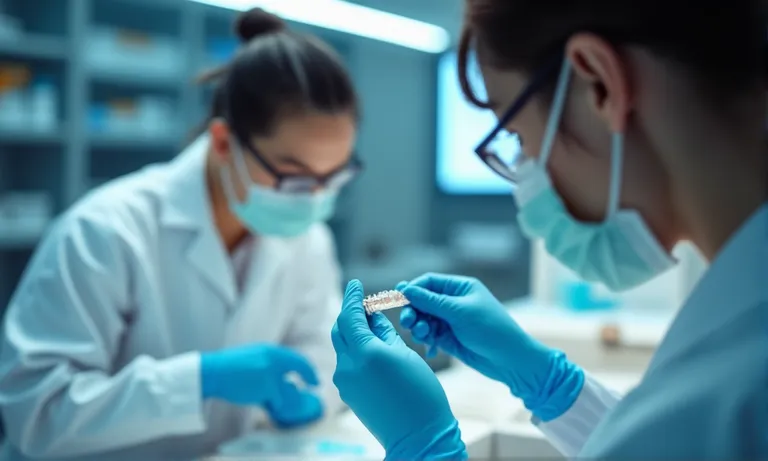
Artificial intelligence and automation are no longer emerging trends—they are transforming every stage of crown and bridge manufacturing with measurable efficiency, accuracy, and consistency gains. For dental labs, DSOs, and clinical procurement teams, evaluating how these technologies are applied is key to selecting partners capable of delivering at scale.
This article explores how AI and automation are being integrated into the digital workflow, with direct impact on both operational performance and clinical outcomes:
By understanding these dimensions, buyers can differentiate between surface-level claims and truly digitized workflows—ensuring alignment with modern clinical demands and long-term partnership value.
AI and automation are no longer experimental in dental manufacturing—they’re quietly transforming how crown and bridge restorations are designed, produced, and delivered. From margin detection to nesting, AI-enabled platforms can now handle entire subroutines once performed manually, freeing skilled technicians to focus on exception handling and final approvals.
ai-automation-in-crown-bridge-production
AI and rule-based automation are typically embedded into five key phases of crown and bridge production:
Labs that integrate these functions typically reduce manual touchpoints by 40–60%.
Here’s a high-level comparison:
| Production Step | Manual Workflow | AI/Automated Workflow |
|---|---|---|
| Margin Identification | Technician defines manually | AI suggests lines with confidence scoring |
| Crown Design | Based on library + human adjustment | Auto-generated, requires only final tweak |
| Nesting | Done visually in CAM software | Layout auto-calculated based on part type and resin flow |
| QC Check | Technician inspects deviation | System flags outliers based on training data |
| Scheduling | Admin tracks manually | AI load-balances printers for deadline/capacity |
Automation does not eliminate the technician—it refocuses their role on clinical oversight and exception resolution.
In real-world use, many dental labs rely on hybrid systems. For instance:
A South Korean partner lab of ours recently implemented 3Shape Automate for overnight crown design. Their pre-existing team used to manually process up to 40 units nightly—now, AI handles the bulk of the work, with the team only reviewing flagged exceptions. Their output capacity doubled without additional staff.
Meanwhile, for print batching, Dentbird’s auto-nesting has helped reduce support material waste by over 20%. By clustering similar case types, it also improved post-cure dimensional consistency.
Labs combining platform logic with technician supervision gain both speed and safety—and they become better partners when you need scalability without sacrificing clinical trust.
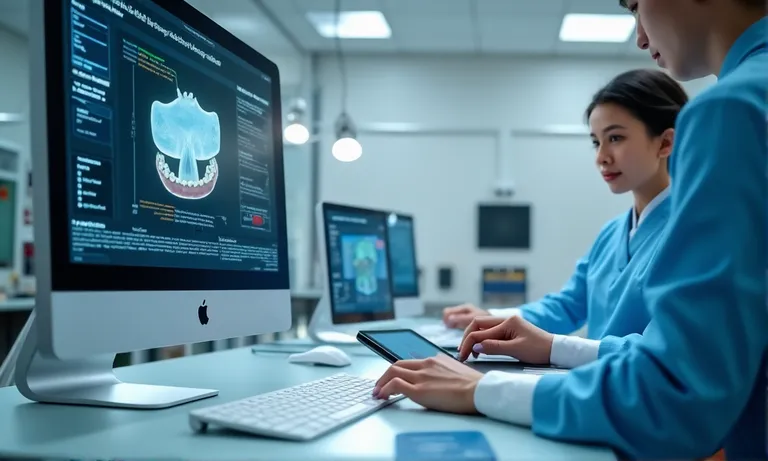
AI-driven dental design tools now outperform manual planning in both speed and anatomical precision. From detecting complex margins to generating natural crown morphology, modern platforms significantly reduce case prep time while maintaining high design quality.
ai-crown-design-margin-detection
Margin detection is one of the most error-prone manual tasks in CAD. AI models trained on thousands of clinical scans can now:
What once required 6–10 minutes of focused work is now completed in under 30 seconds—with revision steps built in.
Studies consistently show AI-aided design delivers superior consistency. A summary comparison:
| Design Metric | Manual Average | AI-Supported Result | Reference |
|---|---|---|---|
| Margin Line Deviation | ±80–100 μm | ±30–50 μm | HKU 3D-DCGAN study |
| Anatomic Fit Deviation | ±60 μm | <40 μm | IntelliDent Trials, Internal |
| Design Time per Crown (avg.) | 8–12 min | <3 min | Raytops Internal Benchmarks |
When paired with robust scan input, these improvements translate directly to reduced adjustment and remake rates.
One of our Chinese lab partners recently adopted IntelliDent’s auto-margin and AI-shape generation engine. On initial test batches of 50 crowns, the technician team reported over 60% reduction in design time—while noting fewer occlusal adjustment complaints from clients.
Their previous workflow relied on template-based morphology, which often required manual smoothing and line revisions. With AI-guided adaptation, most cases now require only minor contact adjustments before approval.
Meanwhile, academic platforms like HKU’s 3D-DCGAN show that deep generative models can produce highly realistic morphology, even when starting from incomplete scan data.
The takeaway? AI isn’t just faster—it introduces a new level of design confidence that scales.
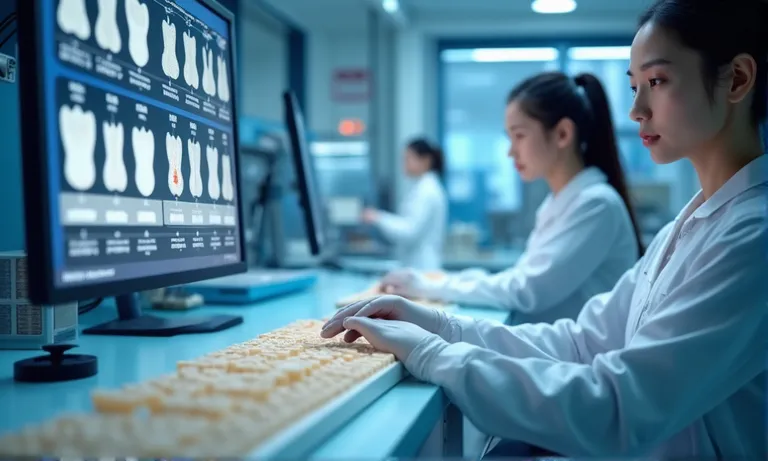
AI-powered batch planning and automated nesting have become key drivers of scale in modern dental labs. By offloading repetitive setup tasks—like layout optimization, support structure generation, and print order scheduling—labs can increase throughput without adding headcount or risking burnout on late-day shifts.
ai-automated-nesting-batch-printing
A typical automated nesting workflow includes:
What used to take 30–45 minutes per batch can now be handled in under 10 minutes with full traceability.
| Scheduling Factor | Manual Workflow | AI-Driven Workflow |
|---|---|---|
| Job Priority Assignment | Technician discretion | Based on deadline, material queue, and SLA rules |
| Printer Allocation | Visual/manual matching | Load-balanced using printer capacity + resin type |
| Reprint Catch-Up | Reactive rescheduling | Auto-inserted into next available slot |
| Nighttime Queue Setup | Done pre-shift manually | Preloaded for auto-launch at 2 AM (example) |
Smart automation enables 24/7 production, particularly when combined with curing automation and RFID-based tray tracking.
One of our East European lab clients implemented Dentbird Batch and auto-scheduling to reduce technician layout work. Their team previously managed printing setup in two 4-hour blocks per day. Post-automation, nesting and scheduling are now completed in 30 minutes total—including QC stage bundling and post-cure stacking.
More importantly, batch-level defect rates dropped by 18% due to better resin grouping and pre-cure heat alignment.
They also noted that by flagging “late-day emergency” jobs through the scheduling layer, same-day delivery rates rose 9% without requiring overtime.
When integrated correctly, automated workflows don’t just increase print volume—they improve consistency and team capacity.
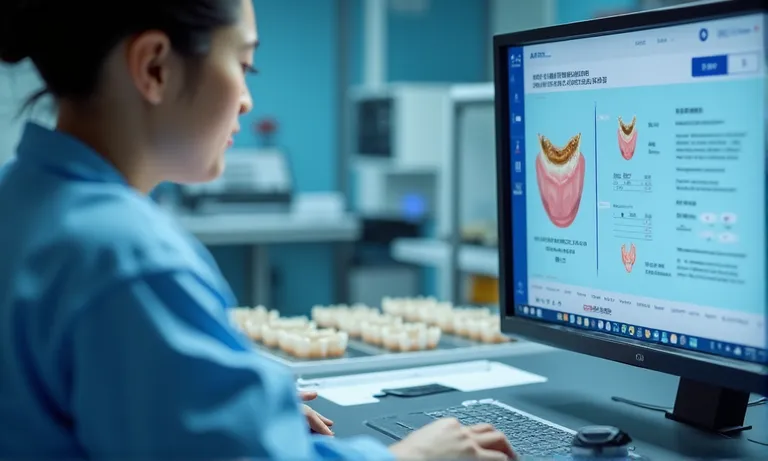
AI-based quality control isn’t just about catching errors—it’s about building traceable, repeatable systems that scale with volume. From deviation mapping to batch-level analytics, AI tools can now flag problems before delivery, not after chairside adjustment.
ai-qc-crown-bridge-restorations
Modern labs integrate machine learning at key checkpoints to:
Some platforms also cross-reference implant library data or connector strength ranges for bridge units.
| Metric | Before AI QC | After AI QC | Notes |
|---|---|---|---|
| Average Crown Remake Rate | 5–6% | <2% | Based on Dentbird + Catalis deployment reports |
| Chairside Occlusal Adjustments | 15–18% | <7% | Per technician logs in multi-unit cases |
| Case Blocking Rate (Pre-delivery) | 3.5% | >7% | AI blocks more—but avoids clinical problems |
Blocking more cases may sound worse—but in reality, it prevents high-cost post-delivery failures and maintains clinician trust.
One of our German partner labs recently deployed a VCAD system to track deviation trends across implant-supported crown batches. They had recurring chairside complaints from two clinics—but inconsistent reports.
By tagging every print with deviation maps and QC status, they traced the issue to a single under-cured resin batch affecting 14 crowns. Once isolated, that material was withdrawn, and a new print validation protocol was implemented for all multi-unit cases.
Since then, batch-level remake rates dropped from 5.2% to 1.4%, and the clinic reported a 70% drop in chairside adjustments.
The point isn’t perfection—it’s predictability. Labs using AI-based QC can fail faster, fix faster, and build accountability over time.
AI is only meaningful if it improves measurable outcomes. From design time to clinical fit, labs adopting automation report gains not just in speed—but in predictability, staffing, and satisfaction metrics that affect long-term partnerships.

ai-crown-design-efficiency-roi
| Process Step | Manual Average | With AI/Automation | Savings |
|---|---|---|---|
| Crown Design (single) | 12–15 min | 3–4 min | ~70% faster |
| Print Nesting Setup | 30–45 min/batch | 5–10 min/batch | ~80% faster |
| QC Review (full arch) | 25 min | 6–10 min (AI triaged) | ~60% faster |
| Chairside Adjustment Time | 5–7 min/unit | <2 min/unit (avg) | ~60% less time |
These savings free up experienced staff to focus on complex cases or customer support—while enabling scale without burnout.
While clinicians don’t always see “how” automation works, they definitely feel the results in chairside performance.
A U.S.-based lab running Glidewell’s CrownAI recently passed 200+ single units/day with only 4 full-time designers—thanks to AI-powered crown generation and batch post-processing.
Before automation, the same volume required 10–12 staff. Not only did labor cost drop, but chairside fit rates improved by 22%, and adjustment time per unit fell to under 90 seconds.
They also noted their average order-to-delivery time went from 3.8 days to 2.2—allowing same-week delivery for 70% of crown cases.
This kind of performance gives sales teams a credible promise—and clinicians a reliable experience.
As more labs market “AI-powered” production, it becomes harder to separate buzzwords from real capabilities. For procurement teams, asking the right questions—and interpreting the answers—can reveal whether automation is embedded in daily operations or just mentioned in brochures.

ai-integration-lab-evaluation
These answers separate labs who truly operationalize AI—from those still outsourcing or testing.
| Evaluation Criteria | Truly Integrated Lab | Surface-Level Claim |
|---|---|---|
| Platform Access | Full license + in-house implementation | Mentions AI vendor in passing |
| Case Evidence | Can show daily flagged/approved cases | No tracked AI decisions |
| QC Reporting | Shows deviation/inspection history | Manual QC with no AI layer |
| Team Roles | Has digital lead or AI-trained staff | Still relies fully on technicians |
| Process Transparency | Offers to walk through case tracking | Talks general “digital workflow” |
Labs that actually use AI don’t just “say digital”—they demonstrate it in how they quote, plan, produce, and respond.
One of our DSO clients in Australia needed to audit a sub-contracted lab’s automation claims before onboarding. They’d received a proposal filled with AI buzzwords—but no details.
We helped the client ask for 3 actual crown cases showing:
Only two cases could be provided—and none showed AI triage or QC automation. Based on that, the DSO paused onboarding and requested further validation.
The experience reinforced this insight: if a lab can’t walk you through one AI-verified case from start to finish, it’s likely not production-ready at scale.
AI and automation are not just future trends—they’re active performance drivers in crown and bridge manufacturing today. Labs that embed these technologies across design, production, and QC are better positioned to offer faster turnaround, greater consistency, and scalable collaboration.
For buyers—from independent clinics to procurement teams at DSOs—partnering with a digitally mature lab means gaining not only technical advantages but also a smoother, more predictable workflow. As an overseas dental lab deeply involved in supporting such transitions, we’ve seen firsthand how the right digital systems translate into real operational outcomes.
When evaluating potential partners, look beyond claims and focus on measurable results, transparent systems, and collaborative support. That’s where long-term trust is built.