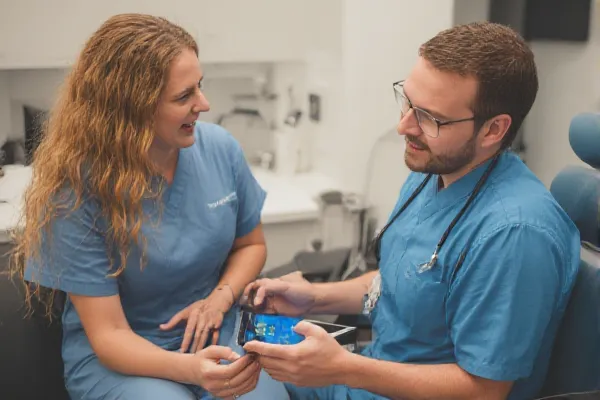
Clear communication is one of the most powerful tools for increasing dental implant case acceptance. When patients understand their options, risks, and outcomes in simple, visual, and empathetic ways, they’re far more likely to say yes. This guide outlines how to explain implant treatments effectively using the right tools, language, and systems.
Explaining implant options with clear language, visuals, and patient-centered framing improves treatment acceptance by building trust, reducing fear, and helping patients understand long-term value. Effective communication transforms confusion into confidence.
Clear communication about dental implants helps more patients say “yes” to treatment. It builds trust, reduces confusion, and makes the decision process easier. When patients understand what to expect, they feel more confident and committed.
Dentist and patient reviewing implant plan
Patients often feel nervous about implant surgery. Many don’t understand the steps or healing process. Clear, calm communication reduces fear and increases cooperation.
Cost is a common concern, but when framed as an investment in long-term health, implants become more acceptable. Position value over price.
Patients may not know the difference between implant-retained fixed restorations and removable ones. Helping them compare options can guide better choices.
| Feature | Fixed Implant Solutions | Removable Overdentures |
| Stability | High – does not move | Moderate – may shift slightly |
| Cleaning | Brush like natural teeth | Must be removed for cleaning |
| Comfort | Feels like real teeth | May feel bulky for some |
| Cost | Higher upfront | Lower initial cost |
Good communication leads to better treatment acceptance and smoother outcomes. When patients understand the plan, they are more likely to commit and cooperate.
✅ Clear explanations increase case acceptance – TRUE
explanation: When patients understand their treatment options, they feel more confident and are more likely to move forward.❌ Discounts alone drive implant acceptance – FALSE
explanation: Lower prices don’t guarantee acceptance. Patients need to understand the value and benefits of the treatment.
Patients are more likely to say yes to treatment when they clearly understand the types of implants available. A simple, structured explanation helps them compare options, ask better questions, and make informed choices.

Implant option comparison chart
Patients often don’t realize that implant treatments vary by how many teeth are replaced. Breaking it down by case type makes it easier to understand.
The way restorations are attached to implants affects maintenance and retrieval. Patients don’t need every detail, but they should understand the basics.
| Feature | Cemented Restorations | Screw-Retained Restorations |
| Retrievability | Difficult | Easy |
| Aesthetics | No screw access hole | May show access point |
| Risk | Residual cement complications | Loose screw risk |
| Maintenance | May require cutting for removal | Easy to remove and repair |
Material choice affects aesthetics and tissue response. Patients appreciate knowing that implant materials are safe and carefully chosen.
Timing is often a concern. Explaining placement timelines helps manage expectations.
Understanding key implant options builds trust and confidence in your recommendation. Clear comparisons help patients feel informed and respected.
Ready to improve how you present implant choices? Reach out and explore how our digital models and case support tools can help.
[Contact Raytops Dental Lab to enhance your implant consultations]
Visual tools help patients connect emotionally and logically with treatment plans. When they can see what implants will look like—and how they work—they’re more likely to engage, ask questions, and say yes to treatment.
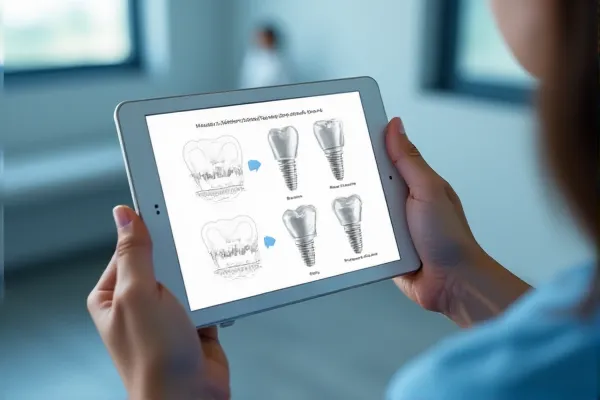
Visual tools for implant consultation
Patients often struggle to imagine their final result. Digital previews help turn abstract promises into visual outcomes.
Hands-on models make implant treatment more tangible. Many patients trust what they can hold.
| Use Case | Value to Patient |
| Full-arch mockups | Helps visualize scale and bite |
| Screw-retained bridges | Shows retention system clearly |
| Comparison of materials | Feels the difference between zirconia and PFM |
| Bone graft simulation | Explains pre-implant preparation visually |
Real cases show real results. Patients want proof—not just theory.
Some patients learn better through motion or interactivity. Videos and apps explain concepts without clinical overload.
The right visuals make implant consultations easier, faster, and more persuasive.
Want to integrate 3D models, digital mockups, or photo galleries into your workflow?
Ask Raytops Dental Lab how we support your patient education efforts]
Even when patients trust you, they may hesitate. Objections like cost, fear of failure, or comparison with cheaper options are normal. The key is to stay calm, validate concerns, and reframe them with clarity and empathy.

Dentist responding to patient concern
Cost is the most common objection. Instead of defending the price, focus on value and longevity.
Fear of failure often stems from not understanding success rates or procedures. Use facts and reassurance, not guarantees.
| Concern | Response Strategy |
| “I’ve heard implants don’t always work” | Explain success rates (above 95%) with good planning and hygiene |
| “What if my body rejects it?” | Clarify that rejection is rare and most issues are mechanical, not biological |
| “What if I get an infection?” | Emphasize hygiene, follow-ups, and proactive care routines |
Patients fear pain and extended downtime. Manage expectations honestly.
Sometimes patients don’t see what makes implants worth it. Use comparisons and case examples.
Objections aren’t rejection—they’re just part of the decision process. Respond with confidence, facts, and empathy to guide patients forward.
Want tools and support that help you answer tough questions?
[Talk to Raytops Dental Lab about patient-ready visuals and FAQ handouts]
The way implant options are explained can influence patient decisions just as much as the treatment itself. When conversations focus on daily comfort, emotional outcomes, and long-term value, patients are more likely to commit with confidence.

Dentist using narrative with patient
Patients may hesitate at the upfront cost of implants. Reframing the price in terms of long-term value helps shift their perspective.
When implants are connected to real-life benefits, they become more than just a product—they become a lifestyle improvement.
| Daily Impact | Dentures/Bridges | Implants |
| Chewing firm foods | Often limited | Stable, natural feel |
| Speaking in public | May shift or slip | Confident and clear |
| Smiling socially | May avoid photos | Feels like their own teeth |
Simplifying the message builds trust. Patients don’t need clinical terms—they need clarity.
Patients connect with relatable stories, not stats. A simple, relevant example can build credibility.
Framing conversations around comfort, value, and relatable stories helps patients feel more confident in their decision. Even small changes in language can make a big difference in case acceptance.
Talk to Raytops Dental Lab for visual tools and case communication assets that support your approach.
Improving case acceptance isn’t just about patient-facing communication—it also depends on the internal systems that support consistency, clarity, and follow-through. When your team is aligned and tools are well-integrated, patients experience more confidence throughout the process.

Implant consultation team workflow
Dedicated coordinators can bridge the gap between clinical explanation and financial clarity, improving patient comfort with big decisions.
Digital consistency reduces confusion. When every consult uses the same messaging and visuals, patients get a clearer picture.
| Tool | Value |
| Slide decks or app-based visuals | Standardized explanations, fewer misunderstandings |
| Preloaded cost comparison tables | Aligns financial expectations early |
| Decision tree templates | Helps team guide patients through choices |
When treatment can be broken into steps, it feels more manageable. Systems that allow for smart scheduling ease the emotional and financial load.
Many implant cases are lost simply because no one follows up. A system for timely check-ins can recover missed opportunities.
Behind every accepted case is a well-prepared team and system. Internal coordination, smart tools, and timely follow-up make the patient journey feel seamless and trustworthy.
Talk to Raytops Dental Lab about workflow-friendly tools and partner-ready resources for smoother case handling.
Strong case acceptance doesn’t start with a discount—it starts with understanding. When implant options are explained through the patient’s lens, backed by visuals and supported by aligned systems, acceptance becomes a natural next step, not a hard sell.
Looking to improve your implant consultations and boost case conversions?
[Contact Raytops Dental Lab] to access visual aids, patient-ready mockups, and system templates designed to streamline implant communication and increase acceptance rates.
Conclusion
Strong case acceptance doesn’t start with a discount—it starts with understanding. When implant options are explained through the patient’s lens, backed by visuals and supported by aligned systems, acceptance becomes a natural next step, not a hard sell.
Looking to improve your implant consultations and boost case conversions?
[Contact Raytops Dental Lab] to access visual aids, patient-ready mockups, and system templates designed to streamline implant communication and increase acceptance rates.
Want to increase implant case acceptance at your clinic? We’ll help you implement proven scripts, visuals, and workflows that turn consults into confident decisions—consistently.