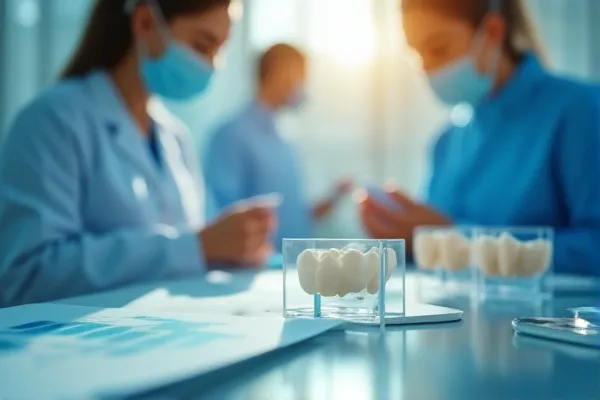
Dental crown pricing can be confusing and inconsistent, especially across regions and labs.
Without clarity, clinics may face hidden costs, unpredictable quality, or overpay for subpar restorations.
By understanding key cost drivers—like alloy content, lab model, and long-term value—dental professionals can make informed, cost-effective crown sourcing decisions.
The cost of semi-precious dental crowns typically ranges from $150 to $450 per unit. Pricing is affected by alloy composition, lab location, manufacturing methods, customization level, and delivery logistics, making supplier evaluation essential for accurate budgeting.
The average cost of semi-precious dental crowns typically ranges between $150 and $450 per unit, depending on region, lab type, and material composition. Understanding price ranges by geography and lab model helps clinics benchmark and plan effectively.
DentalCrownPricing-GlobalComparison
Crown pricing varies significantly by region due to labor, logistics, and regulatory factors.
| Region | Price Range (USD per crown) | Notes |
|---|---|---|
| North America | $250–450 | Higher labor and regulatory costs |
| Europe | $200–400 | Price varies with in-house vs. outsourced labs |
| Australia / NZ | $220–420 | Logistics impact costs significantly |
| Middle East | $180–350 | Growing demand, rising local production |
| Southeast Asia | $120–250 | Lower labor cost, often use offshore labs |
| China (for export) | $80–180 | Export-focused pricing, high volume |
Different lab business models offer distinct pricing tiers.
| Lab Type | Average Price Range | Key Characteristics |
|---|---|---|
| In-house dental lab | $300–450 | Onsite convenience, higher overhead |
| Local boutique lab | $250–400 | Personalized service, limited capacity |
| National chain lab | $200–350 | Standardized output, reliable systems |
| Offshore partner lab | $80–200 | Competitive pricing, reliant on logistics |
| Digital-first lab | $180–300 | Optimized workflows, CAD/CAM-driven |
Several technical variables influence the final crown cost.
The cost of semi-precious dental crowns depends not just on region, but also on lab model, workflow, and materials used. Clinics evaluating suppliers should request itemized quotes to compare true cost per usable unit.
The cost of semi-precious crowns is shaped by three core elements: alloy composition, lab capabilities, and case complexity. Understanding how each contributes helps clinics choose suppliers with true value—not just low price tags.

DentalCrown-CostFactors-Alloy-Tech-Design
Alloy content directly impacts cost due to metal type and purity.
A lab’s internal quality determines how much value each crown delivers.
More complex restorations require more design hours and technical care.
✅ Material, technique, and design complexity all contribute to pricing – TRUE
Crown cost is a sum of inputs—both physical (metal) and technical (labor, expertise).
❌ All semi-precious crowns cost roughly the same regardless of lab – FALSE
Material grades, digital maturity, and technician skills create wide pricing variation even for “the same crown.”
Crown pricing is influenced not only by what goes into the product, but also where and by whom it’s made. Lab location affects operational costs, while reputation signals quality, reducing hidden downstream costs like remakes and delays.

DentalLab-CostComparison-LocationReputation
Geography affects labor, shipping, and even regulatory compliance costs.
Established labs often command higher fees—but also deliver fewer surprises.
| Lab Type | Reputation Level | Cost Range | Value Contribution |
|---|---|---|---|
| New / budget lab | Low | $80–150 | Low cost, higher risk |
| Mid-tier local lab | Moderate | $150–250 | Balanced cost and service |
| Established regional lab | High | $200–350 | Lower remake rate, stronger support |
| Specialized expert lab | Premium | $300–450 | Complex cases, esthetic excellence |
Speed often requires extra investment—but can save costs chairside.
Crown pricing is a layered equation: location sets the base cost, while reputation, speed, and support define long-term value. Understanding how each factor plays out helps clinics choose more than just “a cheap crown”—they choose consistency.
Controlling crown costs is not only about negotiating better prices—it’s also about reducing waste, optimizing supplier collaboration, and improving ordering efficiency. Strategic procurement can lower long-term expenses without compromising quality.
Image
ALT: DentalClinic-CostControl-BulkNegotiation
Prompt: A realistic image of a dental clinic manager reviewing bulk order agreements with a dental lab supplier, charts showing order volumes and savings, clean office setting, natural lighting and digital invoice screen.
Volume drives value—clinics can unlock better pricing through structured agreements.
A good supplier does more than offer a low unit price—they optimize your workflow.
Operational efficiency translates into cost savings over time.
Lowering crown costs isn’t just about negotiating price—it’s about improving systems. To find out how our lab helps clinics reduce real per-unit cost, request a custom volume quote and delivery analysis based on your monthly needs.
Beyond unit price, clinics should evaluate the total cost of ownership—including remakes, patient callbacks, chair time, and clinical trust. Semi-precious crowns often offer better longevity and lower correction frequency, translating into long-term savings.

DentalCrown-LongTermCost-ROI
Total cost of ownership (TCO) includes more than just the lab invoice.
| Cost Component | Impact | Notes |
|---|---|---|
| Unit price | Immediate | Varies by lab and material |
| Remake frequency | Medium–high | Each remake adds chair time and admin effort |
| Fit accuracy | High | Poor margins create adjustment time and refits |
| Patient satisfaction | Long-term | Impacts referrals and retention |
| Warranty support | Indirect | Labs with good policies reduce financial risk |
Well-made semi-precious crowns can minimize long-term clinical and administrative friction.
Return on investment goes beyond price—it’s about time, trust, and consistency.
✅ Total value includes long-term clinical efficiency and reduced remakes – TRUE
Upfront savings can be misleading if they lead to more rework, patient dissatisfaction, or unplanned chair time.
❌ Initial price is the only factor that matters when choosing crowns – FALSE
Short-term cost cuts often create long-term inefficiencies that reduce clinical profitability.
Understanding semi-precious crown pricing goes beyond comparing lab invoices—it requires a deeper look at alloy quality, production workflows, and long-term clinical value. By aligning cost awareness with quality expectations, dental clinics can make smarter, more sustainable crown sourcing decisions.
Want a customized breakdown of your lab spend? Request a personalized pricing and ROI report to identify cost-saving opportunities across your restorative workflow.